AI Strategy
July 2026
·
8 min read
The Cost of Code: How Copilot's Billing Shift Redefined the AI Race
By the Ruvca Research Team · Ruvca Consulting
By the Ruvca Research Team · Ruvca Consulting
Copilot won the first innings of AI coding, but the billing change marked the moment when the category moved from hype to hard economics. Microsoft GitHub Copilot helped define the AI coding boom, but its billing reset exposed a harder truth: in AI, product love is not enough when usage gets expensive. As the market shifted from novelty to cost control, rivals like Anthropic, Google Antigravity, and Cursor gained room to challenge Copilot on pricing, flexibility, and developer experience.
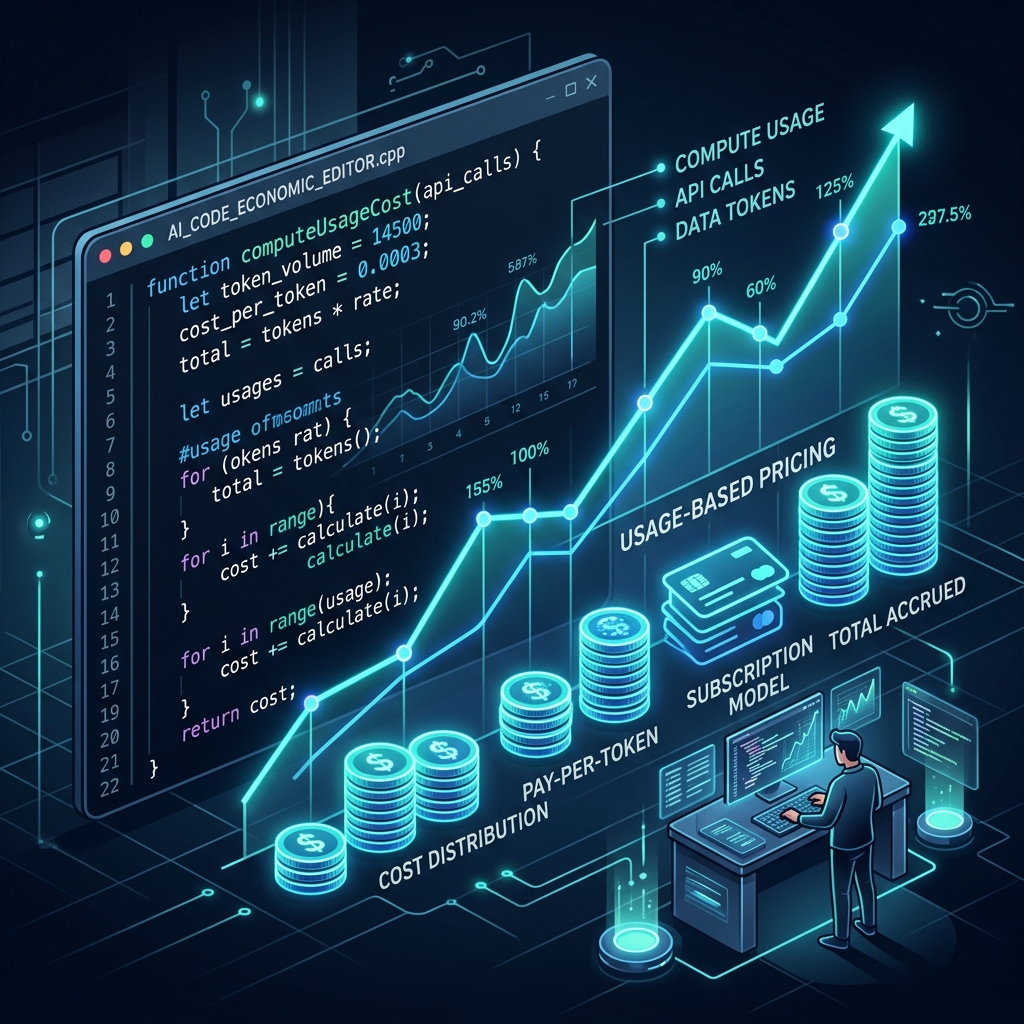
For three years, enterprise AI investment in software engineering felt like a subsidized playground. Developers asked questions, clicked "tab" to autocomplete boilerplate, and corporate sponsors happily paid a flat fee per seat. But in June 2026, GitHub's transition to usage-based AI credits marked the end of the flat-rate era. The industry is waking up to the realities of token consumption and metered infrastructure. This pricing pivot has transformed the competitive landscape, creating new openings for specialized alternatives.
Microsoft GitHub Copilot rose fast because it was first to make AI coding feel real. When GitHub launched Copilot in June 2021 as an AI pair programmer, it brought AI assistance directly into the developer workflow and made code completion feel like a daily productivity tool rather than a novelty. For a while, it looked like Microsoft had found the clearest path to owning AI-assisted development.
Its primary advantage was distribution. Microsoft did not just ship a chatbot; it placed AI directly where developers already wrote code. Because it lived natively inside VS Code and integrated directly with GitHub, it resolved the onboarding friction that plagues new technologies. It established the "tab-completion" muscle memory. For $10 a month, developers could generate unlimited inline suggestions. The business case was self-evident: if Copilot saved a developer just ten minutes a month, the subscription paid for itself.
The flat-rate model worked well when AI was a passive autocomplete assistant. An autocomplete query is simple: the IDE sends a few dozen lines of surrounding code (typically 1K to 4K tokens) to a lightweight, fast-inference model, which returns a single line or block (about 50 tokens). The compute cost per transaction is negligible, easily absorbed by a flat monthly subscription.
However, the category quickly matured. The industry shifted from simple autocomplete to agentic repository editing. Modern agentic workflows do not just suggest the next line of code; they read entire directories, index codebases, run terminal commands, execute tests, and perform multi-file refactoring.
From a compute perspective, this change is not incremental—it is exponential. An agent tasked with refactoring a module must ingest thousands of lines of context (often 30K to 100K tokens) and run multiple iterative reasoning loops using frontier LLMs. A single agentic edit session can easily consume 200,000 tokens of input and output. Scaling this across an engineering organization under an uncapped $10 or $19 per-seat monthly subscription is mathematically unsustainable. The cloud infrastructure bills would dwarf the subscription revenue. Hence, the transition to consumption-based pricing was an economic necessity.
"Agentic AI isn't SaaS; it's compute. When a tool can perform thousands of token operations in a single background loop, selling it as a flat-rate subscription is like selling unlimited AWS server time for twenty dollars a month."
To address this imbalance, GitHub introduced a major billing restructuring in June 2026. The platform moved away from request-based limits, replacing them with a system called **GitHub AI Credits**. Under this model:
Additionally, paid user tiers were mapped to monthly credit allotments. The **Pro** plan ($10/month) includes $15 in monthly credits; the **Pro+** plan ($39/month) includes $70 in credits; and the high-end **Max** plan ($100/month) provides $200 in monthly credits. Once these allotments are exhausted, developers must either purchase add-on credits or face throttling on premium reasoning models.
This transition introduces a new variable into software engineering: developer cognitive friction. When a tool is unlimited, developers use it instinctively. They keep chat windows open for hours, write long, verbose questions, and let the AI process large files repeatedly. There is no cost to trial and error.
With metered credits, the developer is forced to think like a cloud architect. Long chat sessions become liabilities, as the entire session history is re-sent as input tokens with every new prompt. Developers are developing new habits: actively clearing chat histories to clear context, drafting precise prompts, and choosing lighter models for simple boilerplate tasks while reserving premium reasoning models for complex refactoring.
While this encourages context hygiene, it also adds overhead. The developer's focus is split between solving the coding problem and budgeting their token consumption. When credit usage translates directly to operational cost, tool usage ceases to be automatic.
This shift has weakened Microsoft's default monopoly. When Copilot was a flat-rate default, there was little reason to look elsewhere. But once usage became tightly measured, developers began comparing alternatives on an even footing.
**Anthropic** moved into the conversation with a reputation for strong coding and reasoning models. As Claude 3.5 Sonnet set new standards for code generation, developers realized they could get correct answers in fewer iterations. In a metered world, a model that solves a bug in one turn is significantly cheaper than a cheaper model that requires three turns.
**Cursor** capitalized on this by focusing on developer experience. Rather than treating AI as an add-on chat window, Cursor built an AI-native editor with custom context indexing, fast tab completions, and multi-file editing that feels fluid. By providing flexible model options, they gave developers control over their credit spend.
**Google Antigravity** added another competitive pressure point. Backed by Google's massive model infrastructure, Antigravity integrates codebase reasoning, terminal tasks, and cloud deployment pipelines. Because it leverages Google's advanced context-caching capabilities, it reduces the cost of repetitive context loading, directly addressing the token-billing pain point.
For engineering leaders, usage-based AI is a double-edged sword. It aligns cost with value, but it introduces the risk of runaway bills. To manage this transition, CTOs and VPs of Engineering are adopting several strategic practices:
Microsoft still owns a massive share of the developer ecosystem through GitHub and VS Code. But by moving to usage-based AI credits, they have signaled that the era of the free lunch is over. In the new game, the winner will not be the one who offers the cheapest subscription, but the one who can deliver the most reasoning value per token.
Want to optimize AI coding ROI for your organization?
We run focused evaluations of enterprise AI developer tools, helping teams set up cost guardrails, optimize token usage, and implement agentic integrations that deliver clear business value.
Book an AI Strategy Scoping Session