AI Strategy
May 2026
·
7 min read
Beyond Automation: The Age Where Humans Lead and AI Executes
By the Ruvca Research Team · Ruvca Consulting
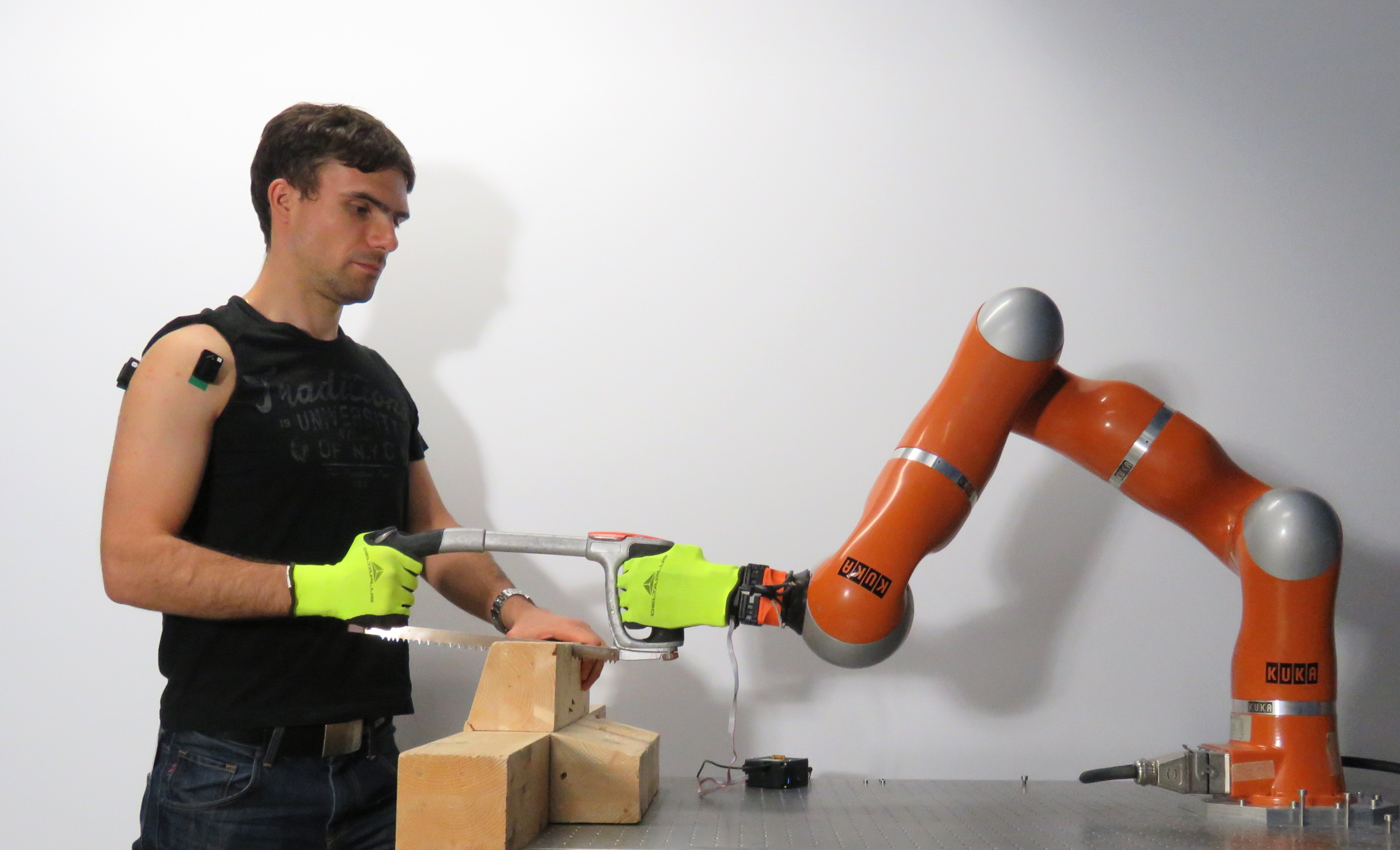
Hero image: Luka Peternel via Wikimedia Commons, CC BY-SA 4.0.
By the Ruvca Research Team · Ruvca Consulting
Hero image: Luka Peternel via Wikimedia Commons, CC BY-SA 4.0.
We are entering what many researchers now describe as the age of co-intelligence: a working model where humans, AI agents, and robots operate as collaborative partners rather than isolated tools. The shift matters because it reframes the conversation. This is no longer about software that merely assists. It is about systems that can interpret intent, reason through options, coordinate actions, and execute bounded work at machine speed while people remain responsible for direction, judgment, and outcomes.
The strongest organisations are not asking whether AI will replace human work. They are asking a much sharper question: what happens when people stay in the lead and AI executes more of the operational burden across digital and physical workflows? That is the real commercial opportunity of this decade.
Co-intelligence is a step beyond basic AI augmentation. Earlier enterprise AI systems typically supported a single task: draft an email, summarise a report, classify a ticket. Useful, but narrow. Co-intelligent systems take a wider mandate. They can execute bounded work across functions, understand high-level intent, sequence intermediate steps, and surface trade-offs while escalating the final judgment to a human leader.
Ethan Mollick at Wharton has described this emerging model as an entangled partnership. That is the right framing. Humans contribute contextual understanding, creativity, ethics, and legitimacy. AI contributes scale, pattern recognition, and execution speed. Neither side delivers the full value alone.
The operating model that matters is not human or AI. It is human judgment directing AI execution across the entire workflow.
The economic case is already large enough to move this discussion out of the innovation lab and into operating strategy. McKinsey Global Institute estimates that 57% of US work hours could technically be handled by AI-powered agents and robots with current technology. More importantly, it projects that effective collaboration between people and intelligent systems could unlock $2.9 trillion in annual US economic value by 2030.
That figure is often misunderstood as a simple automation dividend. It is not. The value comes from redesigning workflows, jobs, and skills so that people, agents, and robots create more together than any one layer could independently. McKinsey also notes that more than 70% of human skills remain relevant across both automatable and non-automatable work, but those skills are being repurposed in partnership with AI rather than exercised in isolation.
The labour market is already registering the shift. Demand for AI fluency, defined less as model-building and more as the ability to use, direct, and manage AI tools, has risen sevenfold in two years. That is one of the clearest signals that the constraint is no longer whether the technology exists. The constraint is whether organisations can redesign work fast enough to use it well.
Accenture's 2026 work on human-AI collaboration is useful because it moves beyond generic productivity claims and shows where value is actually shifting.
AI-enabled working methods do create measurable productivity gains, but the more important dividend is what leadership does with that released capacity. The winners will not be the firms that merely reduce effort. They will be the ones that redeploy faster analysis, shorter decision cycles, and compressed delivery timelines into product expansion, sharper customer response, and better capital allocation.
Job titles are becoming a weaker signal of value than underlying skills. The Wharton-Accenture Skills Index maps work at the task and skill level, then ties those capabilities to economic outcomes in an AI-enabled market. The result is clear: employers are willing to pay a premium for capabilities that machines cannot easily replicate, especially creative problem-solving, leadership, communication, and accountability.
Value at scale requires deliberate job redesign. Roles have to be rebuilt around the work that only people can do, then recalibrated repeatedly as AI capabilities expand. That means trust, clear interaction models, and continuous skill development become operating requirements, not HR side projects. Only 11% of organisations appear equipped for effective continuous co-learning between humans and AI, which means the adoption gap is now a strategic differentiator.
As intelligence becomes scalable through human-AI systems, responsibility does not scale with it. Education, governance, and institutional design have to keep legitimacy, stewardship, and accountability firmly human even as execution becomes more automated. That is the real test of co-intelligence: can we expand capacity without eroding responsibility?
The next phase of this shift is physical, not only digital. Embodied AI is taking the reasoning layer that has matured in software and placing it into machines that can see, move, adapt, and act in the world. That is what makes robotics strategically important now. The question is no longer whether robots can automate a narrow programmed motion. It is whether they can operate with enough perception and contextual adaptability to participate in dynamic workflows alongside people.
Amazon already deploys more than 750,000 robots across more than 20 models in its facilities. That scale is not just an operational anecdote. It is evidence that physical AI is moving into mainstream industrial economics. As reshoring intensifies and labour markets tighten, robotics is becoming a central lever for competitiveness.
Co-intelligence does not remove the need for leadership. It raises the bar for it. Leaders have to define direction, set guardrails, challenge analysis, and own outcomes with final accountability remaining human.
Humans are not merely in the loop. They need to stay in the lead. That is the distinction between responsible co-intelligence and expensive chaos.
The Wharton-Accenture Skills Index also exposes a growing mismatch between what workers signal and what employers actually reward. AI is accelerating the shift from a role-based labour market toward a skills-based economy. That makes recurring empirical measurement more important, because the market is moving too quickly for intuition alone.
The useful questions now are practical ones: which skills are oversupplied, which are scarce, which materially change wages, and how quickly are those signals moving? Organisations that can answer those questions early will hire, retrain, and reorganise more effectively than those still planning around static job descriptions.
AI has moved from novelty to performance driver faster than any prior general-purpose technology. That changes the planning horizon. Co-intelligence is not a distant future state. It is a present operating reality reshaping how work gets done, how decisions are made, and how organisations stay relevant in a constantly moving market.
The future of work is not humans versus AI. It is humans plus AI agents plus automation operating in tandem. The real value comes from end-to-end workflow redesign, not isolated task automation. For companies, this is a growth question. For workers, it is a skill positioning question. For economies, it is increasingly a bet on physical AI as one of the defining technologies of the next decade. The age of co-intelligence is a new industrial revolution, but it will be defined less by substitution than by collaboration and co-creation.
Want to redesign work around co-intelligence, not just automation?
We help leadership teams identify where humans should lead, where agents should execute, and how to redesign workflows so the value is measurable.
Book an AI Strategy Session